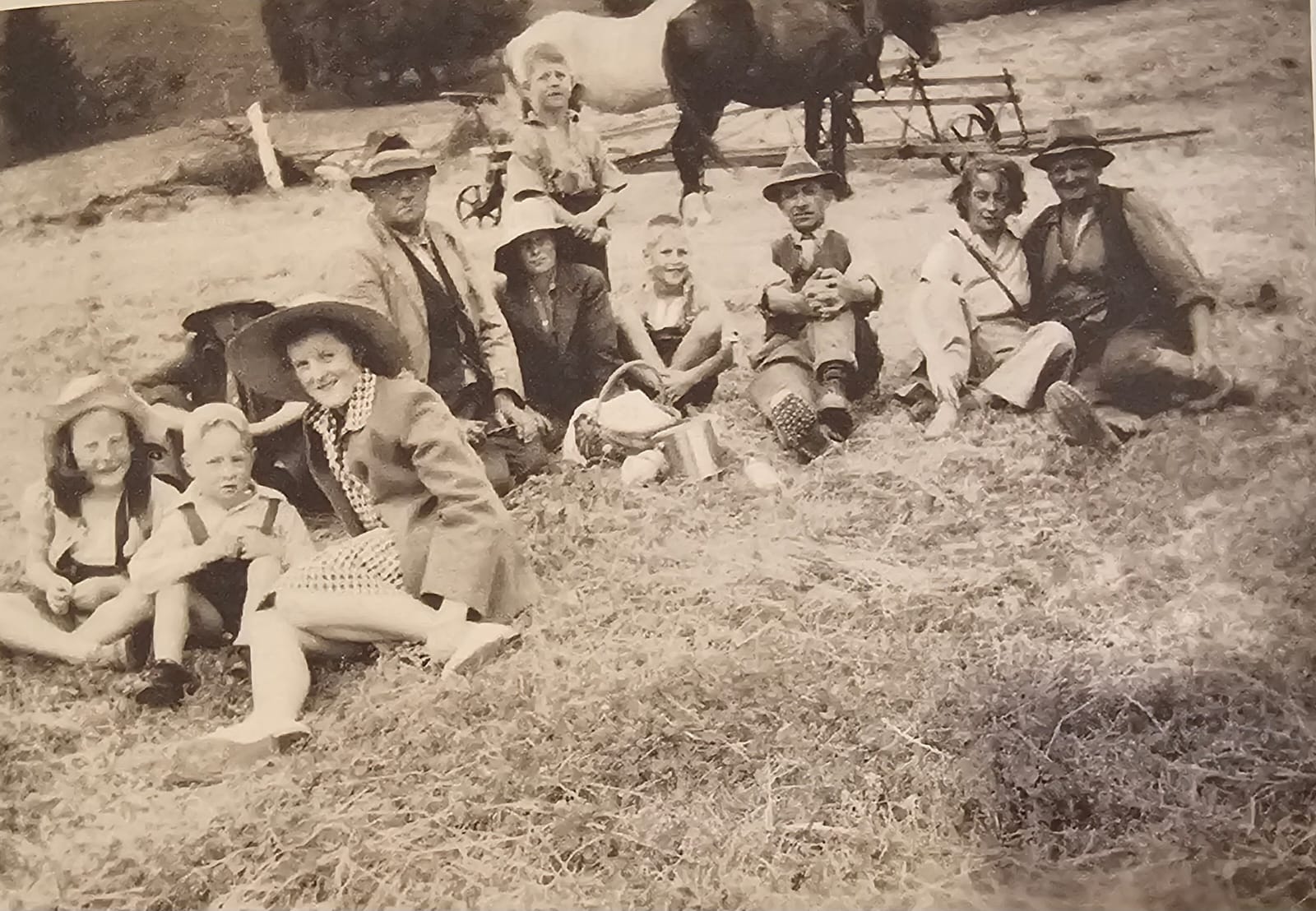
A brief introduction to families who lived in the valley and influenced the history of Cardrona.

Anderson
Eric Anderson from the Mt Barker family of Daniel Thomas (Tom) and Jean Elizabeth Anderson, had a Cardrona connection back through to pioneers John and Rebecca Pearce. He reinstated this connection by marrying Cardrona girl Jean Waters, daughter of Gus Waters, and purchasing the Knuckle Peak run. His brother Morris also returned to the district for a period in the 1960s. Eric and Jean’s son Ray married Mary Cook from Wanaka and acquired the Branch Creek run on his father’s retirement. Ray, a nationally successful trap shooter, has developed a large apiary on the property making use of the abundant clover production in the area. The next generation of the family are now involved in the running of Branch Creek with two of their daughters, Natasha and Isabel in conjunction with Isabel’s husband Glen Curtis, working along side Ray and Mary.
Austin
There are two Austin families associated with Cardrona.
Charles and Alfred Austin were two bachelor brothers, sons of a London solicitor, who first immigrated to Australia then came to Cardrona in the early part of the initial gold rush. Involved in numerous mining partnerships and very willing to contribute to the various committees and organisations in the valley, the brothers were the driving force behind sports and social events and were adept at arranging the required decorations and performing as Master of Ceremonies to ensure the events were successful. Charles died in 1885 having never fully recovered from the leg injuries resulting from the road accident he had near the tree nursery. Alfred lived on his own until he too died in 1902 and was buried at Cardrona. Alfred was very popular to the end, frequently being approached by reporters for information on Cardrona mining.

The second Austin family was that of James Austin, born in Ireland who had married Scottish born Elfeda Millen in 1877. They had a family which included Andrew, William, Elfeda, Annie Jane, Catherine, Hannah, Isabella, Chrissie, Donald, Elizabeth, Allan and Beatrice. James served on local school and mining committees and Mrs Austin became a noted caterer at functions, fulfilled the role of midwife as required and even deputised in the laying out of the deceased in the absence of an undertaker. Three of the Austin daughters married men from Arrowtown; Catherine married George Dudley in 1905; Christina married Victor (Pompey) Baker in 1906 and Elizabeth married Peter Chalmers in 1911. Eldest son Andrew married Elsie Jesperson from the Arrow Junction. Another daughter, Beatrice, married Samuel Howiejohns, son of the Albert Town puntman in 1913. James died in 1915 aged seventy-one years and is buried at Cardrona with his daughter Isabella who had died aged seventeen years old in the main street at Arrowtown after a visit to the doctor. The widowed Mrs Austin moved to Dunedin after James’ death; however, son Donald remained in Cardrona marrying Rachel, daughter of John and Elizabeth Halliday of Pembroke in 1920.
Buckham
The Buckham family had emigrated from County Durham in England to Victoria, Australia. Ralph Buckham and his two sisters, Elizabeth and Margaret, appear to be the only three members of their family to come over to Otago. Ralph was part of the Geordie gang, marrying Arrowtown school teacher in 1877. He later moved to Arrowtown where he died in 1914. His sister Elizabeth married another Geordie member Ralph Halliday but died at Mt Barker in childbirth in 1882. Margaret married a well known Arrowtown and Bullendale gold miner named James Edwards and had an adventurous married life living to the good age of eighty-eight years.
Cotter
Timothy Cotter was originally a miner but switched to butchery and storekeeping in partnership with Patrick Cotter. He married in 1875 and moved to the neck at Lake Hawea in the late 1880’s. Timothy and his wife had twelve children and sadly both parents passed away in 1899 just after buying a farm at Hawea Flat. They left behind a rather large family of young children to be cared for by their elder siblings. Four more members of the family passed away over a two year period including John Cotter, a Boer War casualty. In 1904 the eldest son W.T. Cotter sold the family property to their uncle Patrick Cotter Snr (also a previous Cardrona resident) and moved to Timaru. Patrick Cotter Snr, now approaching seventy years of age, applied for and won a ballot for a property on the Greenfield Estate and moved to South Otago in 1905. Nephew William moved back onto the Hawea Flat farm.
Curtis
In 1976 Martin and Kay Curtis arrived in Cardrona to take on the school bus run. They became exponentially involved in community activities, taking on the rural mail delivery, the Gin and Raspberry horse trekking business, and creating the Cardrona Folk Festival, which is now a well-attended annual event. Presently they are custodians of the public buildings in Cardrona and one son, Glen, is involved in the running of Branch Creek station with his wife Isabel.
Enright
Three brothers and a sister from Limerick, Ireland had come to New Zealand in the 1870’s settling at Gibbston. The youngest brother, Timothy, moved to Cardrona in the 1890’s with his wife Bridget and children Mary, Patrick and Timothy. In 1905 he applied for an “Occupiers Lease” on 100 acres of the old commonage land followed in 1909 by an application for a lease on a block of commonage by his son Patrick. Mary Enright married J.R Scurr Senior at Cardrona and their descendants still live in the Valley today. Patrick Enright married a local girl, Margaret Torrey, at the Cardrona Church in 1920. (Torrie and Torrey are different families). Tim Enright Senior had an orchard at Sawbones, Cardrona and in later life took the surplus fruit on a spring cart to Pembroke for sale. Proceeds would invariably be spent across the bar and upon his journey home would break into song for a period, then apparently doze off. Lucky for Tim, his horse had sufficient initiative to make the journey with minimum supervision. He lived to the good age of eighty-three years dying in 1943. He was buried in Arrowtown with his wife, Bridget.
Fox
John, Thomas and Felix Fox were three pioneer miners who arrived in Otago for the Gabriel’s Gully Rush. They tried their hand in the Wakatipu before Cardrona. Then in 1865 John made an unsuccessful foray into the West Coast. After John’s return to Otago the brothers set up at Cardrona together when the deep leads were being developed. John married Ann McCarthy in 1868 but his brothers remained single. In the early 1880 John made a move applying for land at Hawea Flat where he became known as a race digger encouraging irrigation. Thomas and Felix stayed mining at Cardrona for a few more years before they too moved to Hawea, Thomas continually working alongside Felix rather than operate on his own account. At this time they established a lucrative mine on the Mt Criffel field. With the extra capital they had one of the best financed farms in the district. Both John and Felix had served the Cardrona community and upon moving to Hawea, became involved with the Hawea district committees. Felix, who served as Hawea Flats first postmaster, was unfortunately drowned in the Hawea River in January 1897. The two remaining brothers administered his estate and not long after the accident John sold up the 500-acre property for £1700 to John Kerin and moved to a farm at Studholme Junction in South Canterbury where he passed away in 1906.
Galvin
Patrick (Paddy) Galvin from County Clare had arrived at the Otago Goldfields in 1862 after a period in Victoria. He had a history of hotel keeping in Dunstan and had been living at Shingle Creek before moving to Cardrona around 1890. Although involved in mining he was in demand for social events throughout the district because of his musical prowess. He purchased the Shingle Creek Hotel and some surrounding land in 1900 with one of his sons, James, taking on the licence. Of Patrick Gavin’s children, only his son Patrick Jnr settled in Cardrona marrying Mary, the eldest daughter of Andrew Torrie. They in turn had a large family, James, Jack, Andy, Leslie, Mona, Ettaic, Elizabeth and Doreen. Les, Jack and Andy stayed in Cardrona, whilst Mona married Bob Robins, a Queenstown baker who later became town mayor. Ettie was to marry Charlie Barker, whose family had mined at Mt Ciffel and farmed at Glendu Bay. The couple lived in Cardrona after the war prior to moving to Ben Lomond Station on the Shotover in 1950. Whilst at Cardrona the youngest son Maurice was a final day pupil at the school whilst the other son Henry worked for local run holders and the fledgling Rabbit Board.
Halliday
Two brothers from County Durham, John and Ralph Halliday immigrated to the Victorian goldfields where Ralph married Elizabeth Buckham in 1863. The brothers joined the rush to Otago and arrived in Arrowtown in 1864. After the birth of Ralph’s first two children they made the move to Cardrona. A further six children were born in Cardrona but two were lost as infants. Both brothers were active in Cardrona mining affairs. Following the 1878 flood Ralph relocated his family to a farm at Mt Barker but maintained involvement in Cardrona mining. Ralph died in Cromwell hospital in 1891 whilst John, who continued with gold mining at Cardrona died in Arrowtown in 1907. Of Ralph’s children youngest son Ralph Jnr, after serving in the Boer War, stayed on in South Africa to go mining but died there in 1906. Son Rodger took over the Mt Barker property and served on community committees but moved to Gisborne in 1923 after his wife’s death. Daughter Mary Ann married Robert Norman of Albert Town who acquired a farm on the Glendu Bay Road. Another daughter Margaret married James Torrie of Cardrona at Mt Barker before moving to the Gisborne area.
Jones
An early settler to Cardrona, Hugh Jones worked as a miner and took on waged labouring work. He and his wife Isabella produced a large family before moving to Queenstown in the early 20th century where Hugh died in 1912. Their children included Alexander, Hugh, James, Samuel, William, Isabella, Mary, Grace, Elizabeth, Ella Susannah and Peter. James (Jimmy) known as ‘Plunger’, mentioned earlier in conjunction with 1930’s depression mining, was noted in later years for putting on a comic display for visitors where he rode a broom stick up and down on the main road simulating riding a horse.
Kerin
Brothers Patrick and John from County Clare, Ireland had emigrated to Otago after a time on the Victorian Goldfields. After early mining success at Cardrona Patrick sold out for £20 just before the richest ground was revealed. He moved to Arrowtown and applied for land at Whitechapel where he was rigorously opposed by local miners objecting to the creation of agricultural leases in the goldfields. John Kerin, unlike his brother, reputedly made £1500 from his holding. He expanded his interests in Cardrona opening a butchery and, for a short period, also operated a store as well as farming on land he secured freehold close to the township at Boundary Creek. He and his wife Bridget raised a large family of eight children including James, Patrick, John, Johanna, Catherine, Maria, Bridget and Annie. He took a keen interest in local activities promoting Cardrona interests both commercially and culturally. In 1900 John moved his family to Hawea Flat purchasing the Fox family farm and transferred ownership of his Cardrona land to son James. Kerin’s descendants remained in the Hawea area until recently.
Lafranchi
Geochaimo Lafranchi born 1831 at Goglio on the Swiss Italian border. The Swiss Italian came to Victoria in 1855 then left to try his luck in Otago, leaving his family to follow later in 1870. He tried his hand at hotel keeping at Macetown before settling in Cardrona in 1873. Mrs Lafranchi, who carried on with her husband’s Cardrona business interests after his death, was a Zala and other members of her family mined in the district also. Eldest son Alfred (Alf) born in Victoria while siblings Enrica (Ettie) and Albert were born in Cardrona. They all married Cardrona residents; Alf married Miss Elizabeth O’Callaghan; Ettie married Jim Paterson, the future owner of the Cardrona Hotel and Albert married widow Mrs Jane Main nee Torrie. Alfred and his wife moved to Dunedin around 1940 where he died in 1964. His widow sold their Cardrona lands to Thomas Scurr in 1946. Albert was fourteen years junior to Alfred. He moved down to Gore in the 1920’s living there until his death in 1958.

Lee
Robert Lee returned from military service and came to Cardrona in 1922. His family was from the Palmerston area and he married Daisy Lee from nearby Cardrona in 1928. He farmed at Waiorau for the good wood in preference retiring to Oamaru where he spent forty years before. Bob and Daisy raised five boys. Bert and Hugh took up farming in North Otago. John purchased his fathers property in 1962 and stayed in the Cardrona. Ray was a stock and station agent at Ashburton before returning to Wanaka to assist John with the alpine ski park, Snow Farm, and the youngest Winston went farming in Mid-Canterbury. John married a girl with Wakatipu connections, Mary Alice and together established themselves as the foremost entrepreneurs of Cardrona. The Lee’s are deemed up a number of new business ideas for the district. The next generation appears to be following in their parents footsteps as daughter Jo is a partner in the new Cardrona Farms, which incorporates Waiorau and Tuohy’s Gully runs and son Sam, a joint owner of Snow Park and current chairman of the Cardrona Resident and Ratepayers Association. This family are firmly rooted in the Valley.

(from left) John, Hew, Winston, Ray and Bert.
Little
Walter (Wattie) Little from Glencairn in Scotland arrived in Dunedin in 1866 and secured a shepherding position at Wanaka Station. He was given an advance but had to make his own way to Wanaka. Pay was at a £1 per week plus board. Wattie ventured into the transportation business becoming a wagoner before moving near Branch Creek of Cardrona where he mined and obtained a block of land to farm. Both mine and land were adversely affected by the 1878 flood. He married Mary Small in 1875 and they produced a family of eight: Mary, Walter, Bella, James, Elizabeth, Robert, Thomas and William. Walter restored and enlarged water races that had been ruined by the floods developing a large alluvial sluicing claim at Branch Creek. He profited by selling water to the White Star dredging company. Walter died in 1932 aged eighty-one and was buried in Wanaka alongside his wife who had passed away in 1911. Buried with their parents are two sons, Thomas and William, who died as young men. Son Walter Jnr initially farmed in the Valley before moving to Southland for a time then returned to Mt Barker. He had married Helen Scott in 1903 and died in 1957 they were same age as his father had. James farmed at Cardrona and married Elsie Clark. They had family of six, James, Ellen, (Mrs Bruce Anderson), Walter, Eselda, (Mrs Massey), Dorothy (Topsy – Mrs Peter Anderson), and Robert. James passed away in 1939 aged fifty-nine years. Younger brother Robert never married and after serving in World War 1 lived in Wanaka, the last member of his generation, until he died in 1968.
A second line of Little’s arose in Cardrona with the arrival of Walters nephew John (Jack) Little from Monavie, Scotland in the 1890’s. He married Alicia Welsh, the daughter of an established Cardona resident John Walsh and his wife Catherine nee Broderick in 1904. John Little took up land near his uncle Walter and farmed it until about 1949 when he purchased a property on Littles Road in Arthurs Point, Queenstown. He farmed this land with his son Thomas until his death in 1960. Two children were born to the couple, Thomas, who was to marry Eva McDougall, lived initially at the Lower Township near the Roman Catholic Church then later moved to a farm at Lower Shotover. Catherine married William Armstrong and moved to Becks. Thomas and Eva Little had three children who were final day pupils at the Cardrona School. The youngest, Catherine, returned to the area and served as the Presbyterian Minister at Wanaka where she still lives today. Likewise the fourth child of William and Catherine Armstrong’s family, Catherine Mary, returned to Cardrona after her marriage to Tim Scurr and presently lives in Tuohy’s Gully. The Little’s properties in the Cardrona Valley became incorporated into the Rob Roas and Waiorau Stations.
McDougall
Robert McDougall, born in Glasgow in 1929, was an adventurous man. In his teens he travelled to South America, returned to Britain for a couple of years then emigrated to Victoria. Seven years after his arrival he heard of the Otago gold rush and travelled across the Tasman to join the miners at Gabriel’s Gully. The following year he returned to Scotland where he married Miss Elizabeth Paterson.
Their first child, Robert Jnr was born in Glasgow in 1863 but Glasgow wouldn’t hold the McDougalls for long. Robert decided to bring his new family to the Otago goldfields. Having had the experience of a miner he entered into the retail trade, which resulted in a partnership with well known stockkeeper W. T. Smith at Macetown and Arrowtown.
With the firm expanding to Cardrona Robert moved his young family to the Valley. Robert and Elizabeth had nine children: Robert Jnr, Andrew, John, Jean, Janet, Peter, Alexander, Allen and Annie. Robert and Elizabeth later moved to Pembroke where he established another store. He became known as the “Father of Pembroke” as the result of his fine community initiatives.
Robert lived to the fine age of eighty-six, passing away in 1915 – a great and immeasurable loss to the district. The business had become Robert McDougall and Sons and when the Pembroke store was started Robert Jnr carried on the Cardrona enterprise.
Robert Jnr was to marry Christina Sutherland, the daughter of the Arrowtown schoolteacher, in 1890 and together they ran the Cardrona store and post office until Robert died in 1946 leaving his widow to carry it on. Robert and Christina had three children, John (Jack), Marjory and Eva. Jack took over the store and post office until the late 1950’s. The girls married local Cardrona men Timothy Enright and Thomas Little.

Miller
Three families with this surname were in Cardrona.
Mr John Miller was an Orkney Islander from Stronsay as was his wife Mary Maxwell. John arrived in Otago not long after the Gabriel Gully discovery where he formed a partnership with his future brother-in-law, David Reid. In 1863 both lads were mining on the Arrow and in 1863 they married the Maxwell sisters Janet and Mary at Arrowtown. John then moved his family to Branch Creek, mining there until the turn of the century when they purchased John Kane’s 700-acre farm at Mt Barker. Their children included David, John, Janet (Jane) and Elizabeth. Jane married John Kane Jnr of Hawea at Mt Barker in 1907.
The second Miller family was that of Robert Miller, a popular member of the mining community noted for his musical ability. He married Mary Broderick in 1873; two years later, Mary’s sister Catherine married another Cardrona miner John Walsh. The family moved to Wanaka where Robert died in 1914 and his wife Mary passed away three years later at Luggate. Their children included Robert, William and Mary Millar.
The third family were the family of Henry Miller, also a miner in Cardrona and originally from Hanover in Germany. Henry anglicised his Mueller surname and married an Irish girl, Mary Gallagher (Mary’s sister Bridget married Robert Hodgson). Henry and Mary had a family of nine. Unfortunately Henry died in Cardrona in 1891 leaving his widow with a young family to manage.
Mrs Miller then married a Geordie Gang miner, John Loft, and had another daughter, Chrissie Loft. Her sons Henry Jnr and James (Jim) Millar obtained leasehold blocks above the township. Jim never married and lived at Baumann’s over the river from the township. His brother Henry had two sons, Harry and Ian, with Harry marrying local girl Joan Scurr in the Roman Catholic Church in Cardrona in 1946.
In 1948 Henry Jnr’s widow Muriel married another Cardrona identity, Andrew Torrie Junior. Apart from a block in the Cardrona township, the Miller land was sold to Andy Galvin and the family ultimately ended up in Dunedin.
O’Callaghan
John O’Callaghan was an Irishman from Cork and, in partnership with William Fox, left the Gabriel Gully diggings to be involved with the Arrow discovery in 1862. He dissolved his business partnership with Fox in 1863 taking over all Arrowtown portions of the business. In partnership with Richard Cotter they invested £3000 in a venture on the Arrow Beach only for it to be washed out. John persisted, trying various other mining ventures over the years. He married an Ulster woman, Elizabeth Leebods, in Arrowtown, but after his business interests turned bad came over to Cardrona with his wife and two eldest children in late 1860s.
They built a stone house below the township and had five further children. The bad investments eventually caught up with John and he was declared bankrupt in 1872, his former partner Richard Cotter in the same position a year later. Trouble continued to hound the O’Callaghan’s. The family house was burned out in 1874 but the people of Cardrona rallied around and raised £60 for the family.
John continued mining until his death in 1915. John was known to be a argumentative and combative man manner and was a staunch supporter of the Roman Catholic Church. The family is often known as Callaghan and many of John’s descendants dropped the ‘O’ from their name.
The children who married locals were daughter Julia marrying Cardrona storeholder Mr McLaughlin. They eventually moved to Wellington. Another daughter, Elizabeth, married Alfred Lafranchi, leaving the district in the 1940’s for Dunedin. Son Cornelius married Alice Scurr and moved to Arrowtown in about 1905. Another son, John Junior, returned to Cardrona with his family from the Wakatipu in 1894 but left again at around 1910. Youngest son, Edward, after mining in Cardrona and on dredges elsewhere, was a coach driver on the Crown Range route.
Robertson
Bill Robertson drew the Rob Rosa block in a ballot after World War I. Bill did not have a farming background so asked his father Bob Snr and brother Jim to assist in the venture.
They left their families behind and transported the materials for a homestead as far as Luggate by wagon before setting off to survey the new farm. By May 1924 they considered themselves well enough established to bring the wives and children to Cardrona.

In 1938 Bill and his wife Christine sold out and purchased Hillend leaving Jim, wife Lily and his two sons Bob and Jim Jnr with Rob Rosa. The eldest son Bob enlisted in the army in World War 2 and served overseas. It was at this time that the Little property came on the market. Half was purchased by Jim Robertson Junior and the other half by Bob Lee.
After the war Bob Robertson Jnr left the family to marry Joan Manson of Wanaka and left the home property to go rabbiting at Wanaka Station, eventually moving to Dunedin. Joan has returned to Wanaka where she lives now in retirement.
In 1964 Jim Robertson Snr sold Rob Rosa to his son Jim Jnr and moved to Dunedin. Bill and Chris (Christine) Robertson had two children, a daughter Winnie and a son Walter (Mick). When his parents retired to Dunedin Walter took over at Hillend until he sold out in 1961 moving to Middlemarch.
The MacAvoy family briefly held the Rob Rosa run before being retained by Jim Robertson Junior who was able to augment the property with the purchase of the Smith’s run in 1972. Both Jim’s sons Jamie and Colin were involved with the run but with his retirement to Wanaka in 1987 saw Jamie take over Rob Rosa and Colin became involved with gold mining.
Scurr
From Kirk Merrington, County Durham, David Scurr sailed on the Roslyn Castle to Port Chalmers along with his mother, stepfather and various siblings in 1871. They had been induced to travel to Otago by David Scurr’s older brother Thomas, who as a young man in the company of a maternal aunt emigrated to New South Wales in the mid-1860’s. He then moved to Dunedin where he established himself in engineering creating a flourishing firm. David Scurr in the company of Robert Southold left Dunedin soon after arriving and initially set up at Lake Hayes before deciding to go gold mining in Cardrona.
David had to wait until 1874 before he was able to secure the hand of Annie Stone, a Dorset girl he had met on the ship from England. It was worth the wait and the pair had a large brood of fourteen children with only one infant death, a somewhat lucky occurrence in such a remote location. David formed partnerships with many individuals in his time mining at Cardrona. He was known as a congenial man willing to assist others where he could and was well-liked by his grand children. Three of his siblings from his mothers second marriage came to the Cardrona. Elizabeth Northfield married Robert Stuxdolme, Rachael Northfield married Fred Hancock in 1893 and then went farming at Mt Barker and Joseph Northfield remained unmarried and worked at various labouring jobs until dying in Pembroke in 1922.

Some of David and Annie’s large family married locally. Alice married Cornelius O’Callaghan in 1897; John R. (Jack) married Mary Enright in 1906 and lived out their lives in Cardrona; Phoebe married a miner who worked at Cardrona, Fred Williams in 1907 and ultimately moved to Christchurch; Sarah (Ciss) married Jack Bowler from the Arrow Junction in 1909; in the same year sister Mabel Scurr married dredge employee Fred Lake at the family home in Cardrona.
In around 1910 Dave and Annie were encouraged by their daughter, Charlotte, who had married and settled in Wellington, to try the move north. They moved to the North Island with the remaining unmarried members of their tribe but the south held a special place in Dave’s heart and he often made visits back to Otago. His sons, Thomas and George, both moved back down after their mother, Annie, died in 1916. They operated a scheelite mine at Glenorchy, another wild and beautiful region in the Lakes District.
After World War I David Junior settled in Christchurch and the youngest, Doris, also came south, marrying Nic Halvich in 1922. They settled at Coal Creek and her granddaughter, Mrs Lynette Duncan, lives in Wanaka today.
David Scurr’s son, John (Jack) Robert Scurr’s family is the branch that has kept the Cardrona connection alive. Today Scurr’s still farm and the section generation to do so. Jack and wife Mary had a large family and to support them he gold mined, farmed, ranbitted and even worked as a roadman at Cardrona and, as was the norm of the time, the children were required to contribute where they could.
Mary passed away at Cardrona in 1947 whilst Jack died twelve years later at Cromwell Hospital. Eldest son John (Jack) R. Junior mined and ranbitted in Cardrona and, after his marriage to Molly Fitzpatrick of Arrowtown in 1936, set up home at Branch Creek. After buying Spots Creek run in 1941, Jack took an active role in community affairs, for many years as a member of the Lake County Council and later as chair of the Wanaka County Town committee.
He was also a key driver of the group to save Lake Wanaka from level changes and became a ‘Guardian of Lake Wanaka’. Another son Tom, married Trixie Monson in 1947 and took over the family property at Tuohy’s Gully. Tom passed away in Christchurch in 2001 while Trixie now lives in retirement at Mosgiel.
Other brothers David and George worked in Cardrona before moving away, David to Oamaru, George only moved his family as far as Wanaka. Of the daughters, Joan lived at Cardrona for a while after her marriage to Harry Miller, eventually settling in Dunedin. Daughter Dorothy married Norman Pittaway from Arrowtown and, after a life of farming is now resident in Wanaka.
Children of the next generation to continue living in Cardrona were Jack and Molly Scurr’s daughter Mary who married Allan May and ran Hillend Station after their marriage before moving to Wentworth at Gibbston. Mary is now retired in Arrowtown. Their sons Kevin and John, married sisters Mary and Ann Scott and Kevin took over Hillend, John the family farm at Spots Creek. John chaired the Cardrona Residents and Ratepayers Society for eight years, was active at a national level in the promotion of merino wool and established a renowned trophy hunting business on his run. Both have now retired, Kevin at Wanaka and John to Nelson.
In addition, Kevin’s Gully Tom Scurr’s eldest son Timothy at Tuohy’s Wanaka Tom has been active in with his wife community life and has freely given of his time in community life and has social events. It can be said fostering sporting and social events of the page if many events would never have gotten off the page if Tim had not stepped up. Tim and Cathy are now in the process of handing over the reins to the next generation. Their younger son William, in farming generation works the partnership with John Lee’s daughter Jo, works the combined runs with a natural flair for the land he was born to.
The family tie to the valley continues with eldest son Grant and his wife Jo selling at Studholme Rd and youngest daughter Carolyn and husband Mark just having purchased part of the Spots Creek run.
Studholme
Robert Studholme from County Durham travelled to Dunedin on the Roslyn Castle. He met David Scurr’s family. He, along with Dave Scurr, made their way to Cardrona to take up gold mining as part of the Geordie Gang. From there he continued to court Scurr’s daughter Esther Elizabeth Northfield with whom he had been a fellow passenger and was now established in Dunedin. They married in Dunedin in December 1873 and set up home in Cardrona, Robert building a solidly structured dwelling.

Unfortunately the 1878 flood ruined his home and caused devastation to his mining ventures. He was therefore grateful for the opportunity to operate the tree nursery in the lower valley to re-establish himself. Robert and Elizabeth had a family of six but unfortunately in 1888 he lost both his wife and eldest son John. He then took his family to a property he purchased at the mouth of the Cardrona Valley and in 1909 married Mrs Jane Pispson, widow of Caleb Pispson at the North.
Robert died in 1925 and is buried in Makarora. His youngest son William continued farming, passing away in 1973 aged eighty-six. William’s sons Neil and George continued the farming tradition before the baton was handed to the next generation.
Torrie
James Torrie, a native of Lauder in Scotland, first immigrated to the Victorian goldfields with his second wife Mary and eldest son Andrew, who was born at sea. Four more children were born to the couple but only one, James, survived before they made the move to Otago. In 1866 the last child, George was born in Cardrona, giving the family three surviving boys. James’ wife Mary died sadly in 1869 and he then married for a third time. Mary Patterson was the widow of the Cardrona Creek Hotel and store proprietor. This was a short marriage because the former Mrs Patterson had a problem with alcohol and was dead within two years. James married twice more before his own demise at Cardrona in 1882. Torrie was an interesting character, a true pioneer willing to try whatever possible within his means to get ahead in the new country.
His three sons had a very profitable claim they developed after the advent of the “Morrow” rush. It was stated publicly that they made £3000 each. Andrew, the eldest, married an Irish girl, Sarah McKenna at Arrowtown in 1880 and they had a family of nine. Of his children that married locally, daughter Mary Anne married Patrick Galvin Junior in 1900, daughter Jane (originally married to Mr George Main) when widowed married Albert Lafanchoi and son Andrew Jnr late in life married the widow Mrs Muriel Miller of Cardrona. Andrew Snr moved the bulk of his family to Gore prior to World War I. He died there in 1940 at the age of eighty-six. James the second son married Margaret Halliday in 1890 at Mt Barker before moving away to Gisborne a couple of years later and dying there in 1940. George the youngest must have enjoyed school as he is recorded still at Cardrona School aged seventeen years in 1883. He married in Invercargill in 1894 and ended his days at Gisborne in 1938. When Andrew Snr moved from the district, the Torrie home became the residence of daughter Mary and her husband Patrick Galvin Junior.
Willoughby
John Willoughby arrived in the Cardrona after the initial rush and established a blacksmith. He then set up a store located near the school. Obviously an entrepreneurial man, he extended his business interest with the acquisition of what had been Rebecca Bond’s licensed premises, which he renamed. Willoughby was active in promoting the interests of the district throughout his life particularly notable being his support for a Sunday School class, unusual for a hotel proprietor. With his multiple business interests he provided employment for his family. Both wife and daughter worked at the hotel and his son at the store whilst Willoughby himself still described himself as a blacksmith. He passed away at the age of ninety-one in 1921 and five years later the family sold the business. His wife Isabella, nee McKay, whom he married in 1870, passed away in 1930 at Timaru. Their children included John, James, Harriet, Henry and William. William died as a child.
________
First published in “Cardrona – 150 Years in the Valley of Gold” by Ray O’Callaghan. Some photos added subsequently.