When passing through the Valley to the West Coast for greenstone, the Maori referred to the Cardrona Valley, as the “Dry Valley”. They travelled along the ridgeline because matagouri and speargrass were so thick in the valley and then they descended where there was less matagouri and more manuka at the dryer Mt. Barker end. The early Europeans also commented on the dense matagouri, making progress difficult up the valley floor.
An estimated two to three thousand miners were working in Cardrona during the peak of the gold rush. Three towns formed: the “top” town; the administrative centre, with a Post Office, banks, school, etc. The “northern” town, on Scurr’s property, was mainly light industrial, with the butchers’ killing shed, smithy and repair shops. Six to eight hundred Chinese lived in the third town, “China Town”, on the western side of the riverbed below the second town, alongside the Snow Farm entrance.
Eight hotels were spread throughout the towns at the peak of the mining activity and for every legal hotel there were two grog shops. Two-day race meetings were held on the racecourse, the large flat area next to the Adventure Park. The Europeans watched from the natural grandstand on hillside to the west, and the Chinese in the centre of the oval – the only place the Europeans and the Chinese met was at the tote!
A large number of huts, some houses, and commercial buildings such as hotels etc. were erected to house and cater for the two to three thousand people.
Matagouri, the only firewood, was rapidly cleared. A great help to the fuel supply was the discovery of coal in a side gully, half way from the hotel to the top of the Crown Range. There is no doubt, fire cleared the higher scrubby bushes for sheep to graze. The Government made several thousand hectares available as a miners’ commonage, east and west of the towns. The miners’ committee came to an agreement with the large Pisa Station, that allowed the miners to graze their cattle on the station’s wetter land and Pisa Station to graze their sheep on the dryer commonage land. A happy arrangement.
The main access to the Cardrona valley was by coach over the Crown Range to Queenstown. Stables and a small horse paddock at the summit of the Crown Range road provided a change of horses.
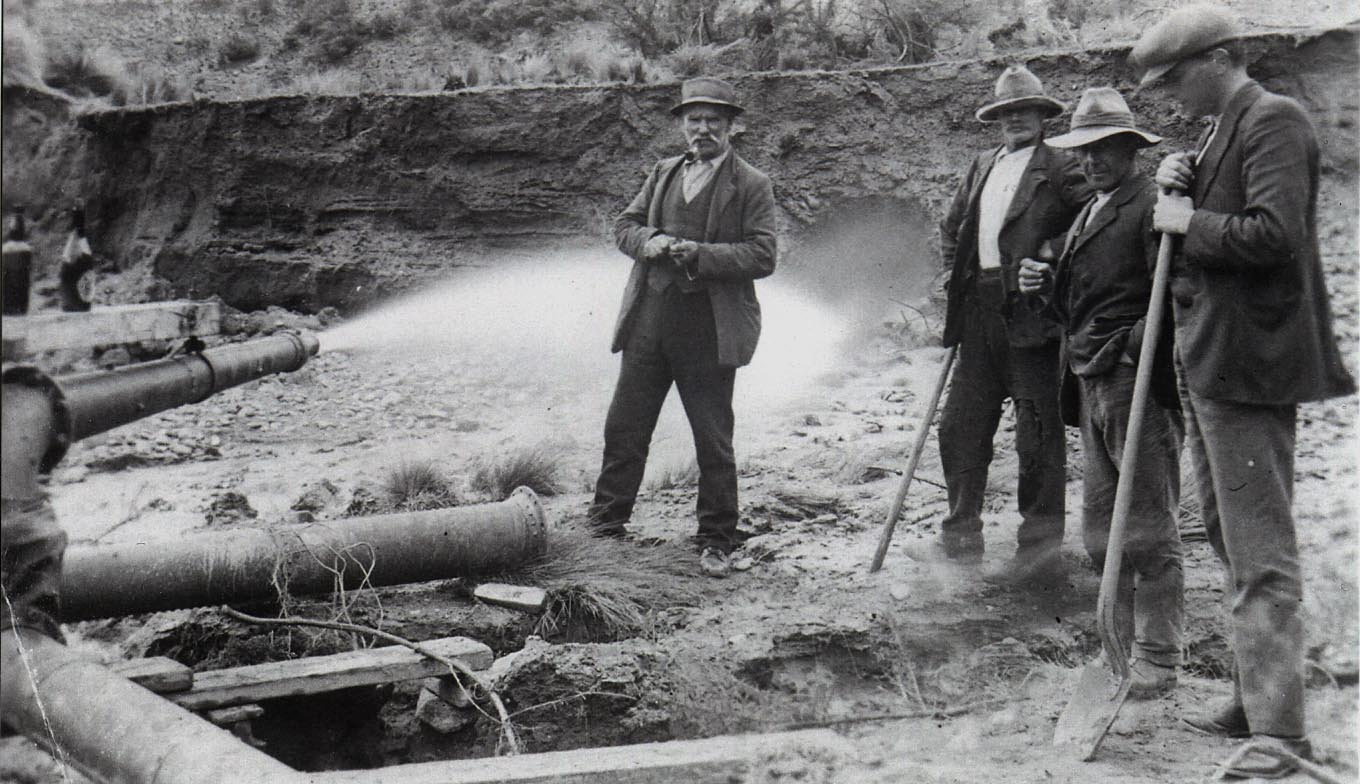
After the early stages of the gold mining period, the easily panned surface gold was mostly exhausted, and six dredges worked in the valley, extracting the deeper gold. Gold was also extracted by sluicing, using water under pressure to wash the soil from the hillsides. The biggest sluicing operations used twenty head of water from the Roaring Meg River, bringing the water around the hillsides in races to the Cardrona Valley. The remains can still be seen today. The mechanisation of gold extraction meant less mining jobs, and many miners had to leave the valley. Two committees were formed during this period (late 1890’s) to create jobs to keep workers in the valley. Both failed.

The Landscape of the valley in 1910 was open; most of the bushes were gone. The middle section, where the main gold was mined, was riddled with workings from tunnelling, shafts, sluicing and dredging. A rabbit paradise. The Government divided the commonage among the remaining residents most of whom were struggling financially.
First published in “Changing Times in the Cardrona Valley” by John Lee