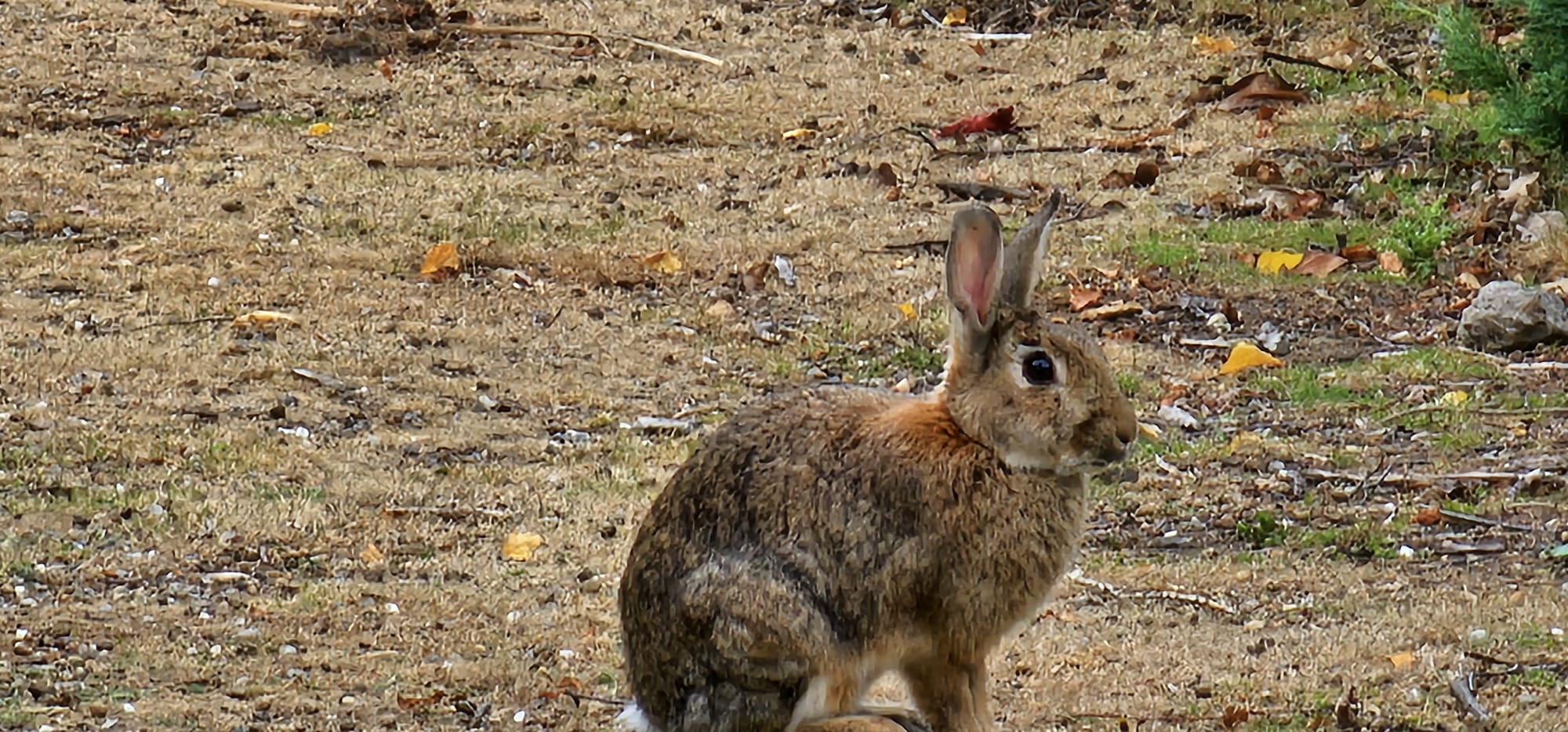
Cardrona farmer J.R. (“Jack”) Scurr (1300ha Spotts Creek Station) had a lifetime’s experience of rabbits. He had to spend two years clearing his farm of them when he bought it – as it had been decimated by the thriving rabbit population.
Jack was asked to present a paper about rabbits to an audience of farmers and industry stakeholders at the Upper Clutha High Country Field Day, held at Glendhu Bay on the 12th of February 1975. There is no doubt that he was very concerned about the impact rabbits could have on farming. He warned that the then new techniques for controlling rabbits, along with the amalgamation of Rabbit Boards, could lead to less effective rabbit control, which would be a disaster for farmers throughout Otago. As it turns out, he was absolutely right.
One of his sons, Kevin Scurr, has kept his father’s original speech notes, still perfectly preserved, so that we can see what he said – word for word. Pictures of the original speech are below, and we have also transcribed it for easier reading on mobile phones.


Jack Scurr’s speech notes – 12th February 1975.
Transcription of the speech:
Where are we going with rabbit control?
Mr. Chairman, Ladies and Gentlemen, I thank you for the privilege of saying a few words to you regarding our rabbit problem. As the effective control of rabbits is so vital to the economy of New Zealand, I would like to think that our younger farmers in particular recognize the potential danger of this menace. We older farmers have experienced it but many young farmers have not.
In trying to determine where we are going with rabbit control, I feel we should have a brief look at how it all started, and would like to express my appreciation to the Department of Agriculture and Fisheries and the Dunedin Public Library for their assistance in searching records regarding the introduction of rabbits into New Zealand.
It would appear that the first rabbits were deliberately introduced into New Zealand about 1838. They evidently did not acclimatize early, and it was not until the silver-grey rabbit was introduced in the late 1860’s that they really started to thrive and from then on increased at an alarming rate, and their effect on the land was indeed frightening.
While all sorts of methods were used to control them, including the importation of ferrets, stoats and weasels, it was not until rabbit Boards were formed in 1948, under the direction with Rabbit Destruction Council, and the implementation of a killer policy along the recommendation that real progress started to be made. The policy of the Rabbit Destruction Council met with success for greater than many of us ever thought possible and while their hope of complete extermination within 10 years may have been rather optimistic it certainly did appear that if we could get scientific assistance and retain our experienced staff and add to them if possible it could well be that extermination could be accomplished. Unfortunately this scientific assistance was not forthcoming, and many Boards were also unable to retain their experienced manpower even so many Boards got very close indeed to getting the last rabbit. For example, the Wanaka Board proved that it re-infestation from other areas could be prevented this was indeed possible and to the best of my knowledge the West Wanaka area has been completely free of rabbits for some years, through a of course being bounded by natural waterways.
Unfortunately over the last number of years the position in this district has deteriorated in some areas more so than others. The chief object of this exercise is to try and find out what has caused this and if possible to try and offer some constructive suggestion as to how the position could be improved. In my opinion the value of our older experienced rabbiters was never fully recognized, and his replacement with inexperienced men soon proved that experience in all phases of rabbit destruction was very necessary. I would like to suggest that all Board employees should go through a training course to improve their rabbit eradication do more harm than good. While we had as the inexperienced rabbiter and dogging I have always considered that this was a certain use for shooting and has had the effect not only of making the rabbit was used far too much, and other methods, but worse still undoubtedly Played a major part in spreading the infestation. Up until 2 years ago, our objective was extermination and I consider that the replacing of this with that of control was a retrograde step. Undoubtedly this had a psychological effect on all concerned as a whole extermination was not in sight, many of us still hoped and considered that science would come up with something that would make this possible and the use of the word control was admitting defeat. It could well be that this is a contributing factor to the unsatisfactory position we find ourselves in today.
Amalgamation. This has been put before us for many years, but generally did not receive a favourable reception from the majority of Boards. While I readily agree that the amalgamation of certain Boards is desirable I have, along with many others, opposed amalgamation on a large scale on the grounds that while administration costs may be reduced that the Boards had with the extra ratespayer representation. In the case of the Central Otago District progress was made after we increased our representation to the maximum. We have now an amalgamation in this area which I consider a satisfactory position to efficient, and while it cannot be blamed for the unsatisfactory position we are in at the present time, what we go and amalgamation a fair go, and if confidence, but we must nevertheless give the that it proves successful. I sincerely hope in the interest of all concerned.
Now what can we do to improve the position we find ourselves in. There is no doubt that the extra cover on our properties to-day along with the desirable increases in stock numbers has made rabbiting much more difficult than it was 15 years ago. I feel that one of the worst problems the Boards have to contend with is the over increasing spread of noxious growth – Briar, Broom and Gorse being the worst. I am sure that Boards along with farmers were indeed disappointed when the Government discontinued its subsidy on weed control chemicals.
Having been a member of the Lake County for over 20 years I regret to say that the noxious growth problem on our farm country has simply gone from bad to worse and is indeed serious. I consider that in the interests of rabbit Board operations and in many cases the future economy of our land that a more positive approach should be made regarding the control of noxious growth. I have been of the opinion for many years that the control of noxious growth should be handled by the Pest Destruction Council, you cannot divorce one from the other, and I know of no organization that could deal with this problem as economically as the rabbit Boards could.
Rabbit Boards in the past have not gone along with the idea. However we are on the eve of sweeping changes in local body administration, and if the Pest Destruction Council were to take on the responsibility of noxious weed control it could well be the means of preserving their identity.
Ladies and gentlemen we should leave no stone unturned if we are going to successfully deal with our rabbits. We are assembled here to-day taking part in a high country Field day. These Field days would never have been worth while were it not for the good work done by rabbit Boards, which enabled extensive development of our high country, and I am sure you feel as sad as I do when we hear and know of areas in this district that only had the odd rabbit here and there a few years ago being now infested all over their low country.
I congratulate the Council on the strong stand it took against any suggestion over rabbit farming, but if what I am told is correct it is now possible in our area for non rabbiters to shoot up to 70 rabbits with a .22 rifle. The next thing we will be faced with will be a move to recommersialize them, and then we would soon be back to where we started.
In conclusion, Ladies and Gentlemen, I respectfully submit that I have not exaggerated the dangerous position that exists at present and it is up to each and every one of us to do our utmost to bring this rabbit problem to a successful conclusion.
JOHN R. SCURR, WANAKA, 12TH FEBRUARY, 1975.